
Miners on lunch break, captured 2025. Workingman’s Death 2005.
Eastern Ukraine is home to the Donbas, a portmanteau of the Donets Basin, itself an abbreviation of the Donets Coal Basin economic region. Coal mining was first established here in 1795, and gradually expanded throughout the 19th century, eventually becoming indispensable to the newly-formed USSR’s rapid industrialization. Driven by Soviet propaganda, workers mined coal at a feverish pace, culminating in the Stakhanovite movement in the 1930s. The movement was named after miner Alexei Stakhanov, who extracted 102 tons of coal in under 6 hours, about 14 times his required quota. Spurred by these feats of productivity, the new movement advocated for the rationalization of the industrial process, encouraged emerging industries to exceed their quotas, and served as a model for the ideal Soviet worker and citizen (Siegelbaum, 2015).
Coal production continued to grow throughout the 20th century and eventually peaked in 1976. However, by the 1980s, the Ukrainian coal mining industry had lost its upward momentum and was beginning to decline. A major factor in this decline was the shift in the Soviet Union’s energy strategy towards hydrocarbons, meaning Siberia — rich in oil and gas — became the new energy frontier. Siberia also contained coal deposits much closer to the surface, leading to open-pit mines which were far more productive than the traditional mines in the Donbas. This shift away from Ukraine as an energy producer coincided with the USSR’s now-stagnating economy, leaving the Donbas especially vulnerable to poverty and collapse (Encyclopedia of Ukraine, n.d.).
By the time the Soviet Union collapsed in 1991, Ukrainian coal had long lost its luster. In the ensuing transfer of state-owned mines to private ownership, many mines had to reduce their workforce or close outright, unable to compete with the vastly cheaper coal now flooding in from global markets. The drawn-out closure of the largest mine, Progress, led to mass unemployment numbering over 600,000. Though exact numbers are difficult to determine, there is no doubt that there were many more who lost their jobs as countless other smaller mines scaled down operations. No longer in the employ of the state, many miners moved on to different industries, with some emigrating to the relatively prosperous Russia in search of a brighter future. However, some miners chose to embrace the emerging trend of private ownership and began working for themselves in small, previously abandoned mines known as kopankas (New York Times, 2007). It is the workers of these illegal kopankas that the first part of the documentary follows.
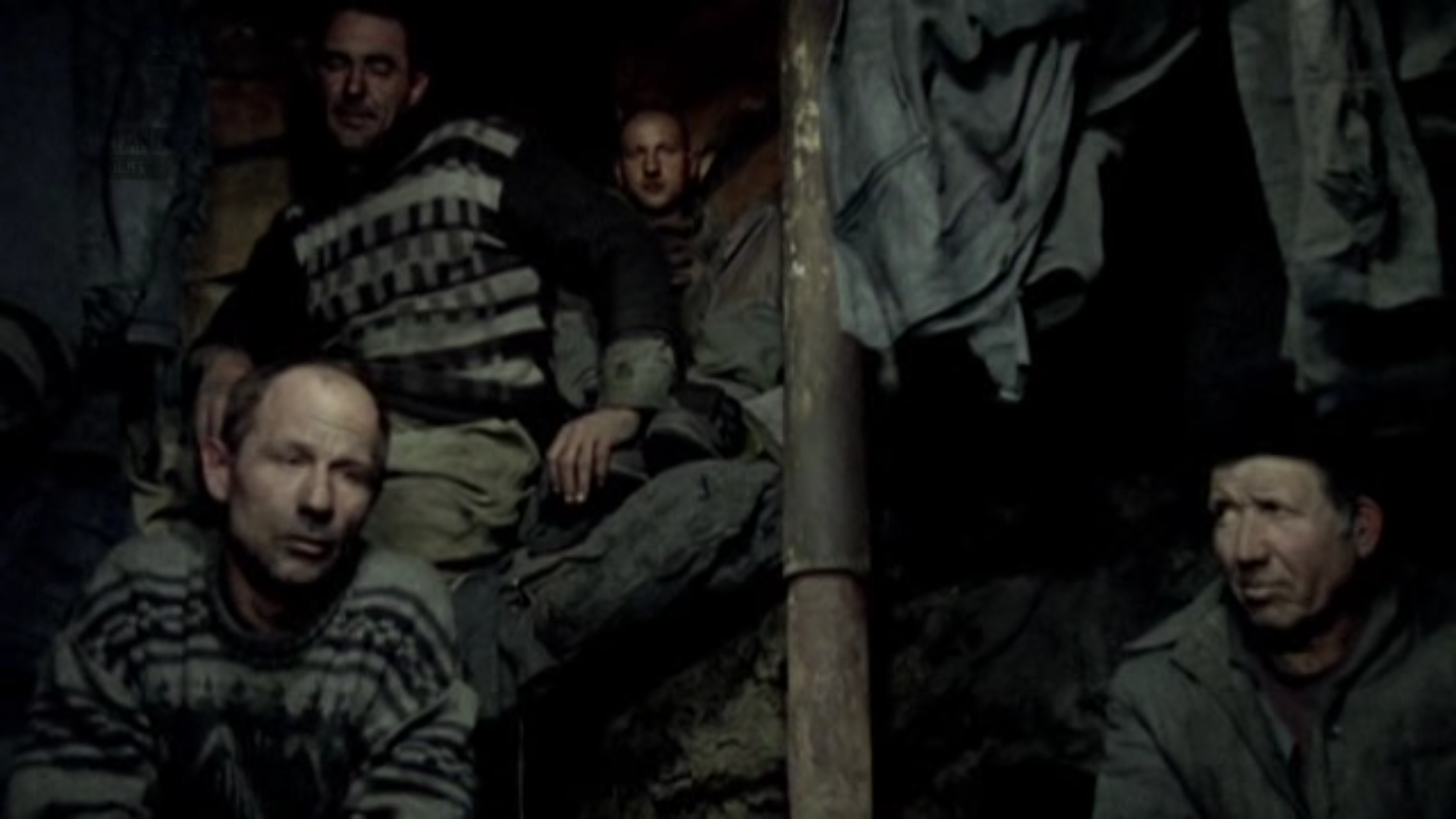
Miners in their resting quarters, captured 2025. Workingman’s Death 2005.
We’re introduced to a desolate landscape on a cold winter’s day. The land a patchwork of snow white and coal black, seeming almost monochrome at first glance. Underneath these hills, we follow our small band of miners as they contort themselves into narrow mine shafts, crawling slowly towards known coal deposits. Once at the correct spot, they begin hammering and picking at small veins of coal, too small and irregular to economically extract using heavy machinery. Deep within the earth, sheltered from the howling wind, the miners beat their hammers against chisels while joking among themselves, one wrong hammer swing away from premature burial. Humor counts for everything in these conditions, though sheer grit never hurt either. Taking a break, they eat while lying on their stomachs, the black coal dust clinging to their food. After lunch, they begin making their way back out, dragging the fruits of their labor behind them. Unlike Stakhanov, it doesn’t seem like they’ve exceeded their quota for the day.
The claustrophobia of the mines is balanced, however, by small vignettes of their home life, showing a degree of levelheadedness and situational acceptance that beggars belief. Faces still smeared with coal, they laugh and joke with their wives and friends. In between the laughing, however, it is clear that they have shed any semblance of the Stakhanovite movement, now mining for survival rather than for any notion as quaint as national pride. The women are not spared the heavy lifting either, with a group of young women shown working in their own little kopanka, wishing things would be different, but accepting that they’re not. We leave our original group of miners as they celebrate one of their retirements, burning his work clothes so he may never have to wear them again. Finally, we cut to a newlywed couple placing flowers at the feet of a statue, possibly Alexei Stakhanov.
One cannot help but wonder what became of these miners in the years since the documentary was shot, around 2004. Years later, from 2010 to 2013, under then-president of Ukraine Viktor Yanukovych, small kopankas began expanding into multi-million dollar enterprises (Vasyliuk, 2023). With money pouring into these operations, heavy machinery was brought in to surface mine the land, causing widespread destruction of natural habitat. These larger illegal mines at one point contributed to 10% of Ukraine’s coal production and became the new destination for local miners who would abandon their own kopankas to work at these larger operations (BBC, 2013).
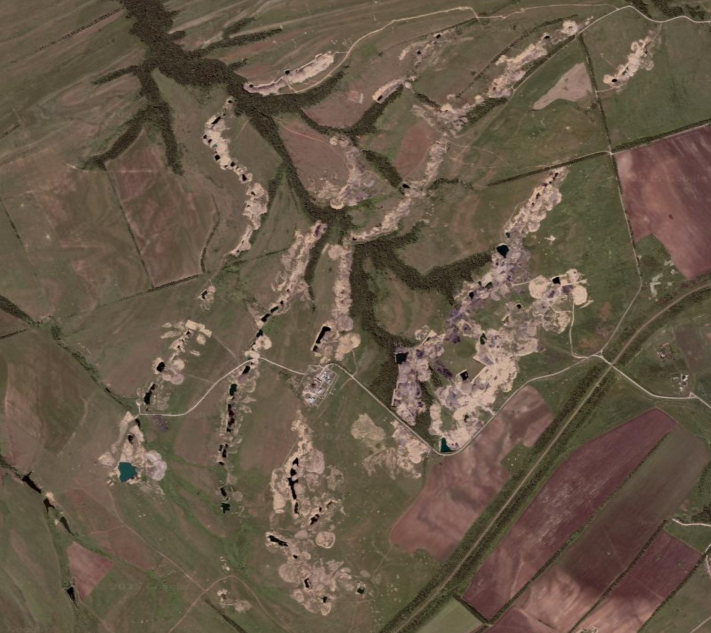
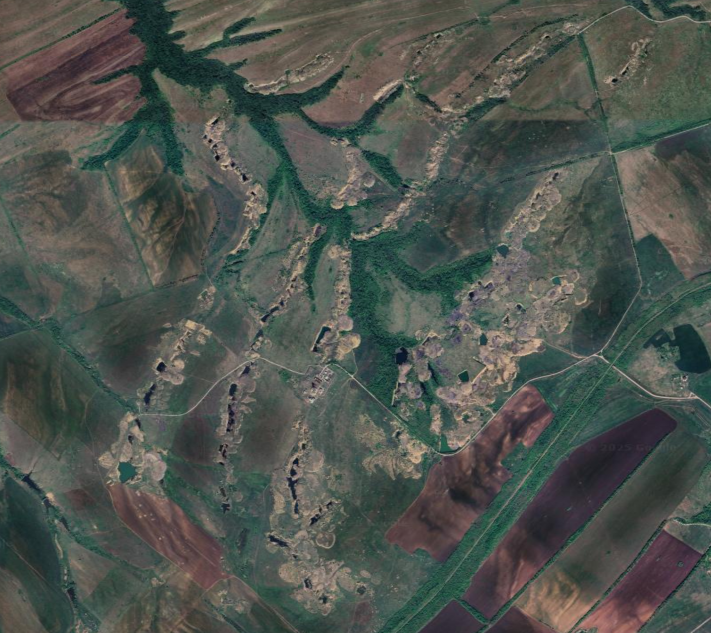
Open pit mines in eastern Ukraine, captured 2015 and 2024. 48°25’22N 38°28’40E. Google Earth 2025
During the 2014 War in Donbas, power outages meant that mines ceased pumping out water, leading to flooded mines that contaminated local water supplies, raised water tables, caused localized flooding, and possibly produced runoff into the Sea of Azov (Vasyliuk, 2023). Even as recently as 2023, Ukrainian and Russian troops battled over the large slag heaps (also known as terrikon heaps), which are the byproducts of mining operations dating back decades. These hills of toxic — and possibly radioactive — materials offer tactical military vantage points for snipers and scouts, and many have died trying to capture these mounds (Baghai, 2023).
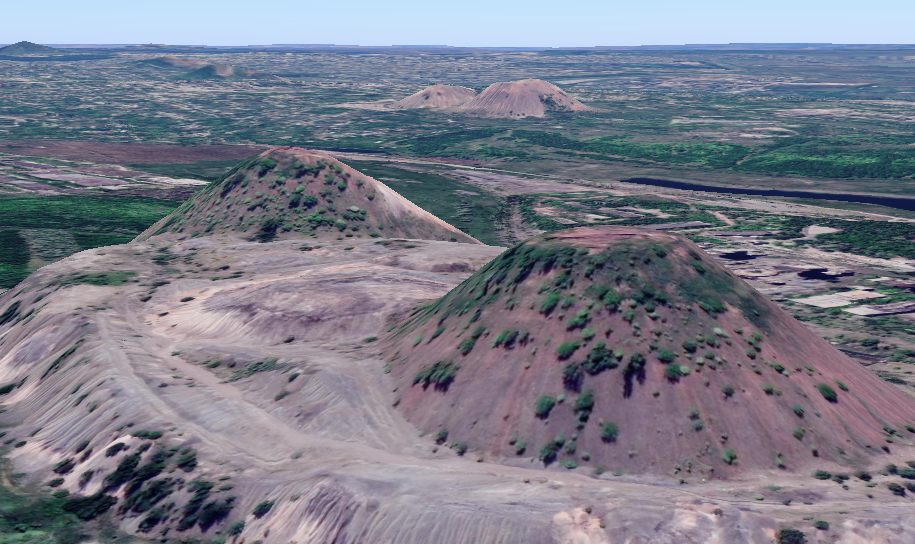
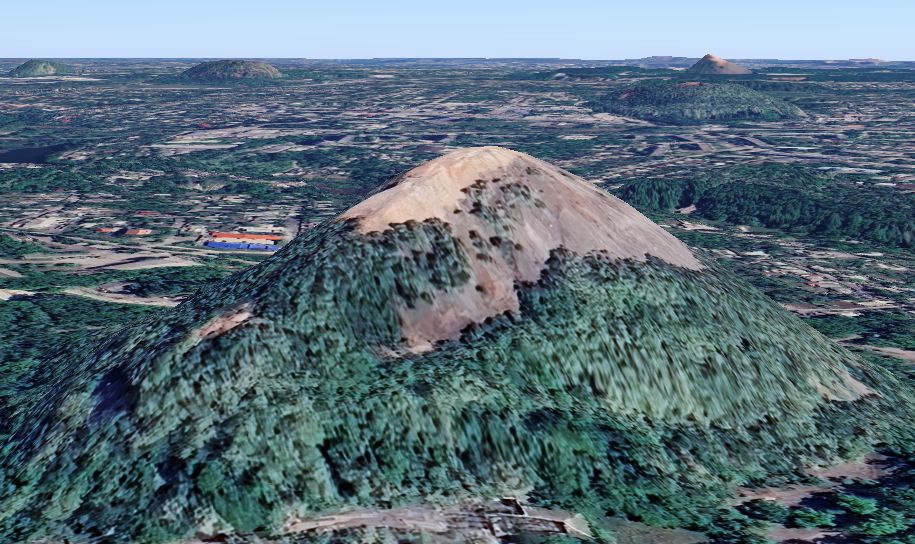
Terrikon heaps, captured 2022 and 2024. 48°21’41″N 37°56’28″E, 48°02’11″N 37°50’35″E. Google Earth 2025
One wonders whether those miners, digging away in their small kopankas, trying to provide for their families, have been able to endure the endless chaos and degradation that surrounds them. Perhaps they’re on to something with their humor — after all, what else could they possibly do but laugh?
References
Vasyliuk, O. (2023). Unregulated coal mining destroys Donbas nature. Translated by N. Müller and J. Castner. [online] Ukraine War Environmental Consequences Work Group. Available at: https://uwecworkgroup.info/unregulated-coal-mining-destroys-donbas-nature/ [Accessed: 15 July 2025].
Siegelbaum, L. (2015). Year of the Stakhanovite, [Online] Michigan State University. Available at: https://soviethistory.msu.edu/1936-2/year-of-the-stakhanovite/ [Accessed: 16 July 2025].
The New York Times (2007). In Ukraine, illegal mines beckon the jobless. [online]. Available at: https://www.nytimes.com/2007/06/18/world/europe/18iht-miners.4.6193394.html [Accessed: 15 July 2025].
Encyclopedia of Ukraine (n.d.). Donets Basin. [online]. Available at: https://www.encyclopediaofukraine.com/display.asp?linkpath=pages%5CD%5CO%5CDonetsBasin.htm [Accessed: 15 July 2025].
BBC News (2013). The coal-mining racket threatening Ukraine’s economy. [online]. Available at: https://www.bbc.co.uk/news/world-europe-22170976 [Accessed: 15 July 2025].
Baghai, C. (2023). The Battle of Terrikon. [online] Medium. Available at: https://christianbaghai.medium.com/the-battle-of-terrikon-4dc8c86b4782 [Accessed: 15 July 2025].