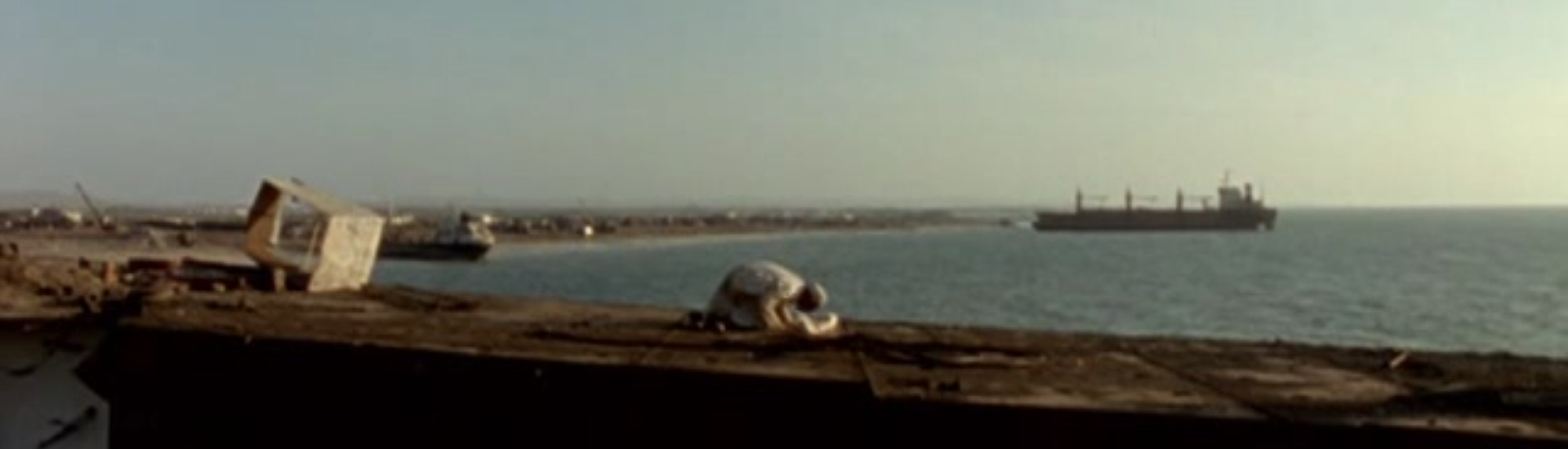
Worker praying, captured 2025. Workingman’s Death 2005.
In 1947, just before Pakistan’s independence, the Gadani ship-breaking yard was founded. This graveyard of rust is where vessels from across the world come to be dismantled for scrap steel (Iqbal and Heidegger, 2013). The yard consists of 135 plots of land owned by various ship-breaking firms. The Balochistan Development Authority (BDA), the government department responsible for improving provincial infrastructure, owns 34 of the plots, which it rents out to private firms (Dastageer et al., 2016).
The yard’s operations expanded substantially after the 1940s. Once only benefiting the local province of Balochistan, it is now a major component in Pakistan’s overall economy. In the 1970s, it was employing 8,000 workers, breaking ships at a lightning pace of four vessels per month. This saved Pakistan around $4 million that would otherwise have been spent on steel imports (Dastageer et al., 2016). Gadani reached its zenith during the 1980s, when its operations expanded to employ over 30,000 workers (Iqbal and Heidegger, 2013). From this point on, however, the industry began to gradually decline.
Ship-breaking is intrinsically linked to the global economy. During economic downturns, shipping companies get rid of unprofitable vessels, no longer able to keep them running. For this reason, Gadani’s decline had many factors, both domestic and international. Domestically, a weakening rupee, increased taxation on the ship-breaking industry, and especially the lack of infrastructure investment, stunted Gadani’s growth. Internationally, safer and more modern yards began operating in India, China, Bangladesh, and Turkey, making them more attractive destinations in an increasingly regulated industry. In addition, cheap Chinese steel began flooding the global market, reducing the demand for labor-intensive scrap steel (Khan, 2023).
Workers come from the adjacent provinces of Balochistan (14.6%) and Sindh (6%), though the majority come from Punjab (25.7%) and Khyber Pakhtunkhwa (52.2%) (Iqbal and Heidegger, 2013). The workforce also includes migrant Rohingya, Bengali, and Burmese (NGO Shipbreaking Platform, n.d.). Workers are hired as independent contractors, earning about $4 per day. Being contractors, their employers are not responsible for providing them with sick leave, health insurance, pensions, or safety equipment. All of this in an industry where death and maiming are commonplace and expected (Dastageer et al, 2016).
Unfortunately, unions do little to improve these conditions. The only labor union operating at the site, the Ship-Breaking Labour Union, encourages workers to elect their labor contractors as union leaders, leading to a peculiar scenario where the employers themselves become union leaders. Corruption within the union is also a concern. According to a 2016 Herald article, the Pakistan-wide National Trade Union Foundation (NTUF) alleges that union leaders at the yard had bribed local government officials. Allegedly, the bribes succeeded in convincing officials to de-register two competing unions that had recently been created (Dastageer et al., 2016). Union issues aside, the accommodations for the workers do not even constitute the bare minimum for a workers’ colony. While there are makeshift sheds constructed from scrap metal, there is no potable water, no gas, no nearby hospital, and for the workers who have brought their families along, no schools (Iqbal and Heidegger, 2013). It is against the backdrop of these appalling conditions that the documentary follows the breakers of Gadani.
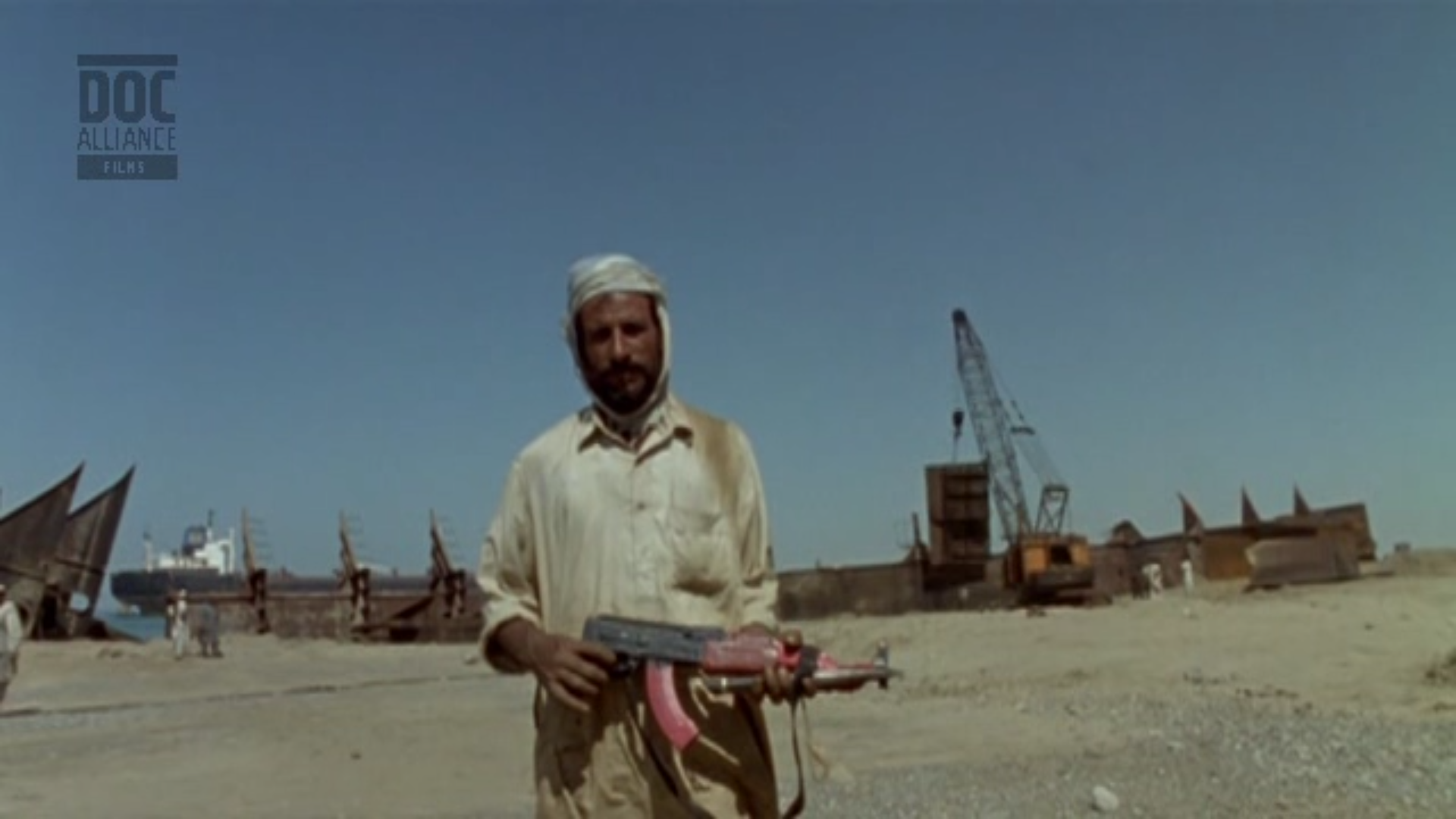
Worker posing with a fake gun, captured 2025. Workingman’s Death 2005.
In the main yard, workers are attending prayer in preparation for a dangerous day’s work. Having bolstered their spirits, they head towards a newly beached ship and ascend it, some using freshly cut holes in the hull, others climbing the anchor chain. Walking along the deck of the vessel, they seem undaunted by the sheer scale of the task. Wielding their oxyacetylene torches, the breakers begin dissecting the ship at a hypnotically slow pace. Knowing the job will take time regardless of speed, the breakers stay relaxed, almost lethargic. After each section, they rest, discussing how to break up the next part of the ship over cups of tea. Once sections are cut, they are pulled off the vessel using onshore winches and slowly dragged up the beach for further dismantling.
Inside the bowels of what seems to be an oil tanker, we see sparks rain down the sides as the bow and hull are gradually separated. The breakers on the top deck are crouched for comfort, slowly cutting across the ship horizontally. When all the cuts have been made, the breakers stand in silence, their still-burning torches gently hissing. The stillness is interrupted by the sound of the onshore winch’s diesel engine coming to life. It begins pulling the slack from the chains hooked to the bow, straining the pulleys in the process as they creak with immense forces. Slowly, almost imperceptibly, the bow is pulled away from the ship. Light begins creeping through the cuts, the interior beginning to illuminate like a steel cathedral. The bow is pulled past its tipping point, and from there on, gravity takes over. Seemingly in slow motion, the titanic metal face descends like thunder, crashing onto the beach, creating great plumes of dust that race inland towards the shore. As the dust settles, the bow begins to sink ever so slightly, settling into the wet sand. The day’s work is done.
The workers go back to their meager quarters. They wash using buckets of water, change into clean clothes, eat food, and rest on the floor. Some listen to the radio, some play with their pets. Others are starting their shift, piling all the metal from the day into large, rust colored mountains of sharp steel. Alone atop the remains of a ship, a worker bows towards Mecca.
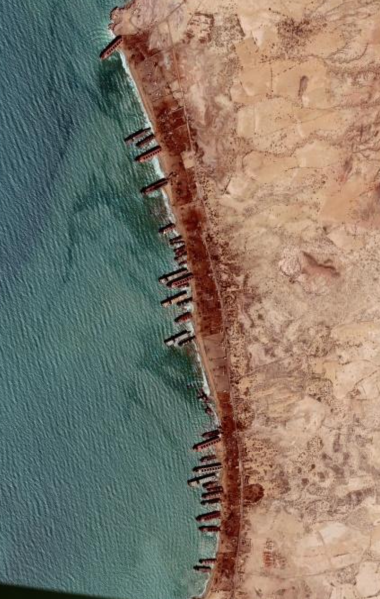
Ships being dismantled at Gadani, captured 2017. 25°03’21N 66°42’42E. Google Earth 2025
Undeniably, the breakers generate a lot of value through their hard work. Annually, they recover 1.2-1.5 million tons of steel, contributing Rs12 billion ($114.64 million at 2016 rates) to the Pakistani economy through taxes and savings on imports (Dastageer, 2016). While many of the ships are from developing nations, between 2010 and 2013, EU-based companies sent 149 ships to Gadani for breaking (Iqbal and Heidegger, 2013). This varied supply of ships, along with the unknown nature of their cargo, means breakers never know if the vessel they are dismantling will be their last.
On October 22nd, 2016, the MT ACES beached onto plot #54. The ship had previously been a midsize oil tanker, but had been converted into a floating production storage and offloading unit (FPSO) in 2007 — essentially a floating oil refinery (HRCP, 2016). On the night of October 30th, 2016, workers climbed onboard the vessel and went to sleep, hoping to get an early start the next day.
At the time of demolition, MT ACES had been used by the Jakarta-based company PT Sinar Mentari Prima, which specializes in industrial-grade lubricants. In 2016, the ship was sold to Chaudhry Abdul Ghafoor, the owner of plot #54, through a middleman. The flag had also been changed from Indonesia to Djibouti about two weeks prior to the purchase (NGO Shipbreaking Platform, 2016). This practice, known as Flag of Convenience (FOC), is often done to sidestep environmental regulations such as the Basel or Hong Kong Convention, which ensures ships are free of any hazardous material before dismantling operations begin.
The workers woke up on the morning of November 1st, 2016, and began dismantling MT ACES. The early morning went well, but at around 9:40 a.m., something onboard ignited, and in the confines of the ship’s interior, the ignition turned into an explosion. The ensuing blast tore open the top portions of the ship in an instant, along with whoever was standing on it at the time. Fire began to engulf the entire vessel, both on the top deck and in the interior. As chaos ensued, firefighters, including those from neighboring regions, battled the inferno for three days, until it eventually ran out of fuel (Dastageer et al., 2016).
With no documentation to keep track of assigned workers, a definitive list of casualties was difficult to determine. The only person who knew the exact numbers was Gul Zameen, the inexperienced yard manager who had assigned workers to the task. Zameen died in the incident, along with his son and nephew (Arqam, 2016). Over time, it emerged that there had been 29 fatalities and over 60 injuries. A majority of the dead had been killed during the initial blast, their dismembered limbs reportedly strewn across the yard. Others were burned alive, unable to escape the ensuing fire. Some jumped off the ship, but were either unable to swim and drowned, or died on impact with the shallow beach. Some survived the initial dangers, but died en route to the nearest hospital in Karachi, over one hour away. Many of the survivors were left with severe, permanent burn wounds (NGO Shipbreaking Platform, n.d).
An investigation led by Federal Minister for Defense Production, Rana Tanveer Hussain, asserted in December that MT ACES was illegally carrying approximately 1,600,000 liters (1,600 tonnes) of industrial lubricants and 1,400,00 liters (1,400 tonnes) of diesel. This kind of smuggling is commonplace at Gadani as a way to offset the high duty costs of purchasing ships. However, an independent investigation later found that the official cargo report handed to the captain of the vessel listed 27,000 liters (27 tonnes) of diesel, 30,000 liters (30 tonnes) of lubricant, 132,800 liters (132.8 tonnes) of furnace oil, and 1,100,000 liters (1,100 tonnes) of sludge. Whatever the real value, the cargo likely contributed to the explosion that took the lives of so many men and injured many more (HRCP, 2016).
Eventually, it came to light that Gul Zameen, the inexperienced yard manager in charge of operations that day, had prematurely given the order to begin hot work before another team had finished cleaning out the ship. Cleaning beached ships of hazardous materials such as oil, fuel, and sludge is standard procedure, though evidently, they are unenforced. Zameen’s order was given in an apparent effort to meet a deadline imposed on him by the plot owner, Abdul Ghafoor, who promised a permanent position if Zameen managed to dismantle the vessel in 45 days (HRCP, 2016). Abdul Ghafoor had purchased MT ACES before the disaster and is currently in hiding due to a case of criminal negligence being lodged against him (Dastageer et al., 2016). The case attracted national attention in Pakistan, with some parts of the media fueling baseless conspiracy theories involving Indian terrorism.
In October 2012, before the MT ACES incident, three workers died when a fuel tank fell on top of them (IndustriALL Global Union, 2012). In January 2017, five workers were burned alive onboard the LPG tanker RAIN, possibly when combustible foam was ignited (Waste Management World, 2017). In November 2017, close to the anniversary of the 2016 MT ACES explosion, the same vessel caught fire again, though thankfully with no casualties (NGO Shipbreaking Platform, 2016). In June 2021, the FSO RADIANT had beached at Gadani while carrying 1,500 tonnes of mercury sludge. Workers had already been dismantling the ship for three weeks before they became aware of the toxic material. Multiple government agencies refused to accept blame, leading to overall confusion as to how the ship managed to dock (Khan, 2021). In January 2024, two workers were crushed to death by a falling steel plate (NGO Shipbreaking Platform, 2024). The further we go back in time towards 1947, the less we know. The deaths listed here are undoubtedly an underestimation.
In 2025, after decades of senseless death, dangerous working conditions, union strikes, measly pay, lack of facilities, and falling global competitiveness, the Pakistan government finally decided to invest Rs12 billion into Gadani ($42 million at 2025 rates)(Arab News Pakistan 2025). The money will go towards a 30-bed hospital, residential blocks, a school, a public park, and a clean water supply. It seems that after decades of death and struggle, the workers finally have access to the bare minimum.
References
Khan, N. (2023). Once the world’s largest graveyard for vessels, Gadani beach now a sinking ship. [online] Arab News. Available at: https://www.arabnews.com/node/2377836/pakistan [Accessed: 18 July 2025].
NGO Shipbreaking Platform (n.d). The problem: Pakistan. [online]. Available at: https://shipbreakingplatform.org/our-work/the-problem/pakistan/ [Accessed 18 Jul. 2025].
Dastageer, G., Hasnain, S. and Binte Rashid, A. (2016). Wasteland: The ugly side of Gadani’s ship‑breaking industry. [online] Dawn Herald. Available at: https://herald.dawn.com/news/1153615/wasteland-the-ugly-side-of-gadanis-ship-breaking-industry [Accessed: 18 July 2025].
Iqbal, K.M.J. and Heidegger, P. (2013). Pakistan Shipbreaking Outlook: The Way Forward for a Green Ship Recycling Industry – Environmental, Health and Safety Conditions. [online] Sustainable Development Policy Institute and NGO Shipbreaking Platform. Available at: https://shipbreakingplatform.org/wp-content/uploads/2022/01/SDPI-NSP-Pakistan-Position-Paper-For-Printing_compressed-compressed.pdf [Accessed: 18 July 2025].
NGO Shipbreaking Platform (2016). NGOs denounce dangerous working conditions after major explosion at Gadani shipbreaking yard in Pakistan killing at least 21 workers. [online]. Available at: https://shipbreakingplatform.org/press-release-ngos-denounce-dangerous-working-conditions-after-major-explosion-at-gadani-shipbreaking-yard-in-pakistan-killing-at-least-21-workers/ [Accessed 18 July 2025].
Human Rights Commission of Pakistan (2016). Horror in Gadani: Report of an HRCP Fact‑Finding Mission. [online] Available at: https://hrcp-web.org/hrcpweb/wp-content/uploads/2020/09/2016-Horror-in-Gadani.pdf [Accessed: 7 August 2025].
Arqam, A. (2016). Gadani: An Accident Waiting to Happen. [online] Newsline Magazine. Available at: https://newslinemagazine.com/magazine/gadani-accident-waiting-happen/ [Accessed: 18 July 2025].
IndustriALL Global Union (2012). Another three die at Gadani shipyard. [online] IndustriALL Global Union. Available at: https://www.industriall-union.org/another-three-die-at-gadani-shipyard [Accessed: 18 July 2025].
Waste Management World (2017). Five More Deaths at Gadani Ship Recycling Yard in Pakistan. [online]. Available at: https://waste-management-world.com/artikel/five-more-deaths-at-gadani-ship-recycling-yard-in-pakistan/ [Accessed: 7 August 2025].
Khan, N. (2021). Weeks later, no clarity how toxic tanker mysteriously beached at Pakistani ship‑breaking yard. [online].Arab News. Available at: https://arab.news/55vnx [Accessed: 7 August 2025].
NGO Shipbreaking Platform (2024). Two workers killed at Gadani shipbreaking yards. [online]. Available at: https://shipbreakingplatform.org/two-deaths-in-pakistan-2024/ [Accessed: 18 July 2025].
Arab News Pakistan (2025). Pakistan approves $42 million to transform ship-breaking yard into ‘model green facility’. [online] Arab News Pakistan. Available at: https://www.arabnews.com/node/2605790/pakistan [Accessed: 18 Jul. 2025].