
A steelworker tapping a blast furnace, captured 2025. Workingman’s Death 2005.
The meteoric rise of China’s steel industry cannot be separated from its turbulent 20th-century past. Transforming from a disorganized, colonized state into a global superpower nipping at the heels of the United States, China’s story is one of incredible progress at great human cost.
Following the resolution of the 1904–1905 Russo-Japanese War, Imperial Japan was left in control of Southern Manchuria along with the South Manchuria Railway line, operated by the Mantetsu company from 1906 onward. During this time, the Kwantung Army was also created, which was a branch of the Imperial Japanese military tasked with overseeing security and economic development in southern Manchuria. In time, the Mantetsu Company expanded beyond railway operations into various industries, including ceramics, oil, glass, flour, and most importantly, steel. In 1916, Mantetsu created the Showa Steel Works subsidiary, establishing the manufacturing base for the occupying Japanese forces and cementing their dominance in the region. Showa Steel Works’ role was further solidified after the Mukden Incident, a false-flag operation conducted by the Japanese in 1931 as a pretense to fully invade Manchuria and establish the puppet state of Manchukuo. Puyi, the last emperor of the Qing dynasty, was placed on the throne as a puppet monarch. This new state of Manchukuo began funneling the private wealth of zaibatsus (powerful, vertically integrated businesses) into state-owned industries, with Showa Steel Works seeing massive investment through the newly created Manchurian Industrial Development Company.
Manchukuo’s expansion came to an abrupt end in the final days of WWII. In August 1945, the Soviet Red Army invaded Manchuria and swiftly defeated the Kwantung Army. Following the operation, as the Soviets began withdrawing from Manchuria, they dismantled Showa Steel Works and shipped its components back to the USSR (Steelonthenet, n.d.). Manchuria was reclaimed by the CCP in 1948 during the Chinese Civil War, and the remains of the Showa Steel Works were rebuilt into the Anshan Iron & Steel Works (Angang), ready to serve the emerging Chinese state. The CCP’s first Five-Year Plan under Mao Zedong lasted from 1953 to 1957, prioritizing agricultural development and heavy industries such as fertilizer, cement, and steel. From 1952 to 1957, steel production in China quadrupled from 1.3 million tonnes to 5.2 million tonnes (Chinese History for Teachers, n.d.). Production continued to increase at a steady pace until the 1978 economic reforms under Deng Xiaoping shifted China’s socialist economy to a market-driven one. As it opened up to the global market, China experienced unprecedented growth in the steel sector, with production growing from 37.1 million tonnes in 1980 to 355.8 million tonnes in 2005 (World Steel Association, 2014). It is amid this economic miracle that the documentary interviews the steel workers of Angang, caught up in the inescapable sense that they are part of something far larger than themselves.
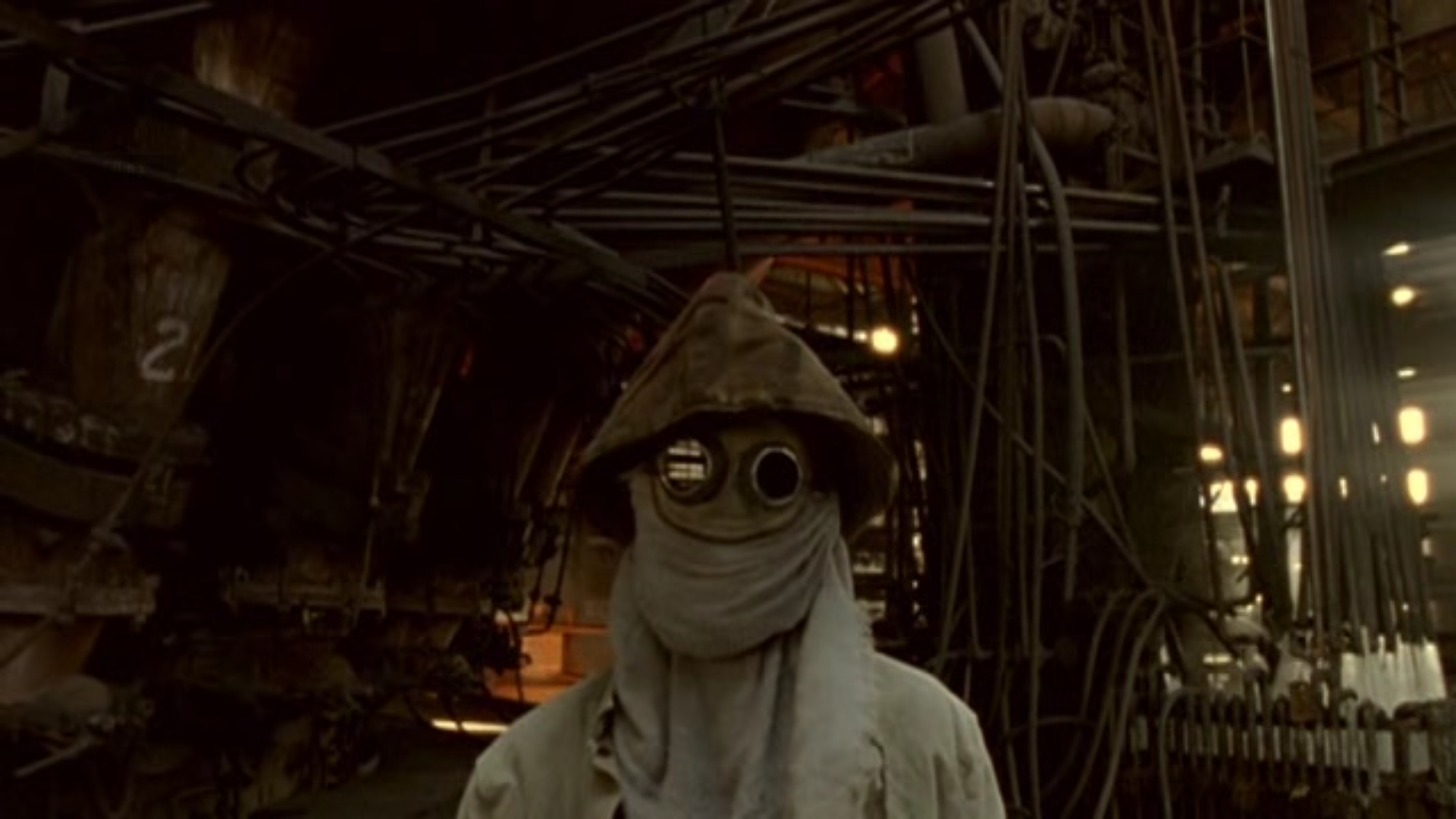
Steelworker posing for the camera, captured 2025. Workingman’s Death 2005.
In the city of Shenyang, in the center of a large square, a statue of Chairman Mao Zedong is illuminated at night, flanked by epoxy sculptures of workers from the Cultural Revolution. Underneath the statue, the elderly are practicing tai chi with measured movements. Others, possibly state employees, are writing calligraphy on the floor. The square seems peaceful, but this calm evening scene is interrupted by the powerful voice of an unknown narrator. The voice—a woman’s—is imploring the youth of China to make the best of their vitality and strength. To use their gifts to serve China in the years to come is the best outlet for their vigor.
More than an hour southwest, in the nearby city of Anshan, the Anshan Iron & Steel Works roars with fire. Steel workers tap the base of the blast furnace using an oxygen lance, their flimsy garments somehow offering protection against the blizzard of sparks emanating from the molten metal. The impure slag pours out, leaving only the end-product molten steel. Sitting off the work floor, steelworkers are interviewed about the nature of their job and its future. Unlike other chapters, there is an obvious sense of greater purpose among everyone here, aware of the fact that they are participating in one of the most significant moments in Chinese history. They make no attempt to hide the difficulty of their work, nor the pride they gain from it. In the live-portraits taken of them, they gently sway against a backdrop of steel towers and tangled wires, a jungle of metal and fire inhospitable to all but those clad in makeshift armor.
Back at the statue, now daylight, a student notices how much the city has grown and modernized. She recounts how her friends sometimes pose in front of the statue and emulate the gestures of the workers and soldiers. The lessons of her ancestors are finding new forms to take, as China marches onward towards the future.
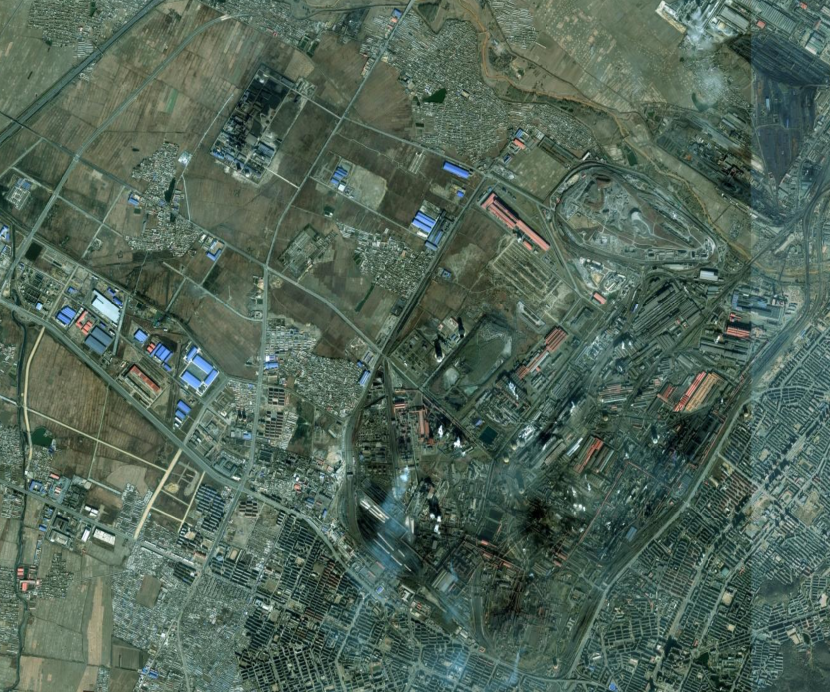
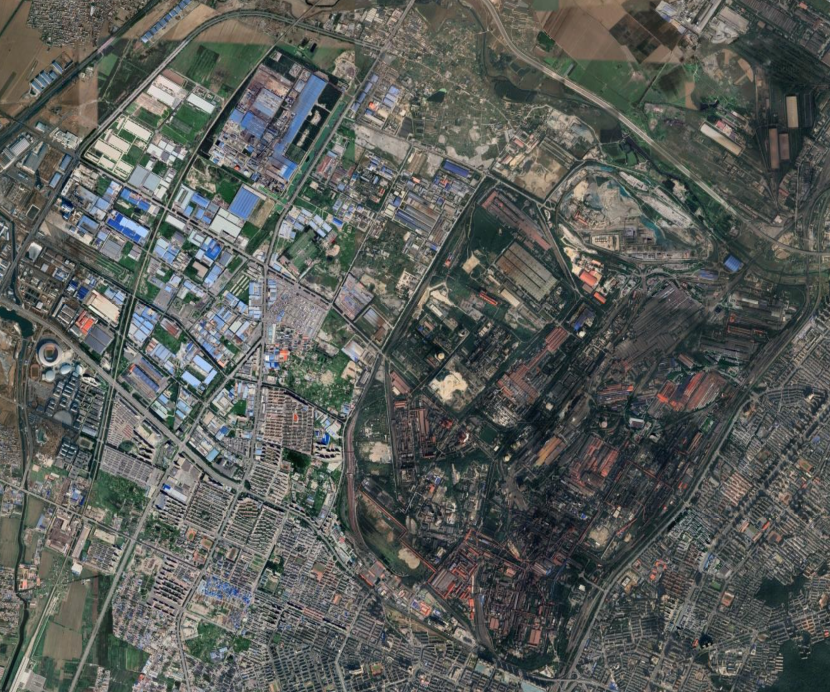
Anshan steel works, showing major industrial expansion in the northwest, captured 2007 and 2024.
41°09’06N 122°58’07E. Google Earth 2025
The rise of China in the years after the documentary is too varied and expansive to cover in this essay. However, even when focusing solely on the steel industry, China managed to produce an astonishing 1 billion tonnes in 2024 (World Steel Association, 2024). In a globalized world, this titanic growth creates ripples that spread far beyond national borders. China’s industrial overproduction, coupled with a weakened construction sector reducing domestic demand, has led to steel flooding the global market. This glut of cheap steel has made the domestic steel industries of many nations far less competitive, triggering a cascade of steel plant closures and job losses. With livelihoods at risk, it seems that regardless of whether work is confined to national borders or exported abroad, the workingman always gets the short end of the stick.
References
Steelonthenet (n.d.). History of Ansteel. [online]. Available at: https://www.steelonthenet.com/kb/history-ansteel.html [Accessed: 20 July 2025].
Chinese History for Teachers (n.d.). First Five-Year Plan – Overview. [online]. Available at: https://chinesehistoryforteachers.omeka.net/exhibits/show/first-five-year-plan/first-five-year-plan-overview [Accessed: 20 July 2025].
World Steel Association (2014). Steel Annually 1980–2013. [online]. Available at: https://web.archive.org/web/20150420161500/http://www.worldsteel.org/dms/internetDocumentList/statistics-archive/production-archive/steel-archive/steel-annually/steel-annually-1980-2013/document/steel%20annually%201980-2013.pdf [Accessed: 20 July 2025].
World Steel Association (2024). Total production of crude steel. [online]. Available at: https://worldsteel.org/data/annual-production-steel-data/?ind=P1_crude_steel_total_pub/CHN/IND [Accessed: 20 July 2025].