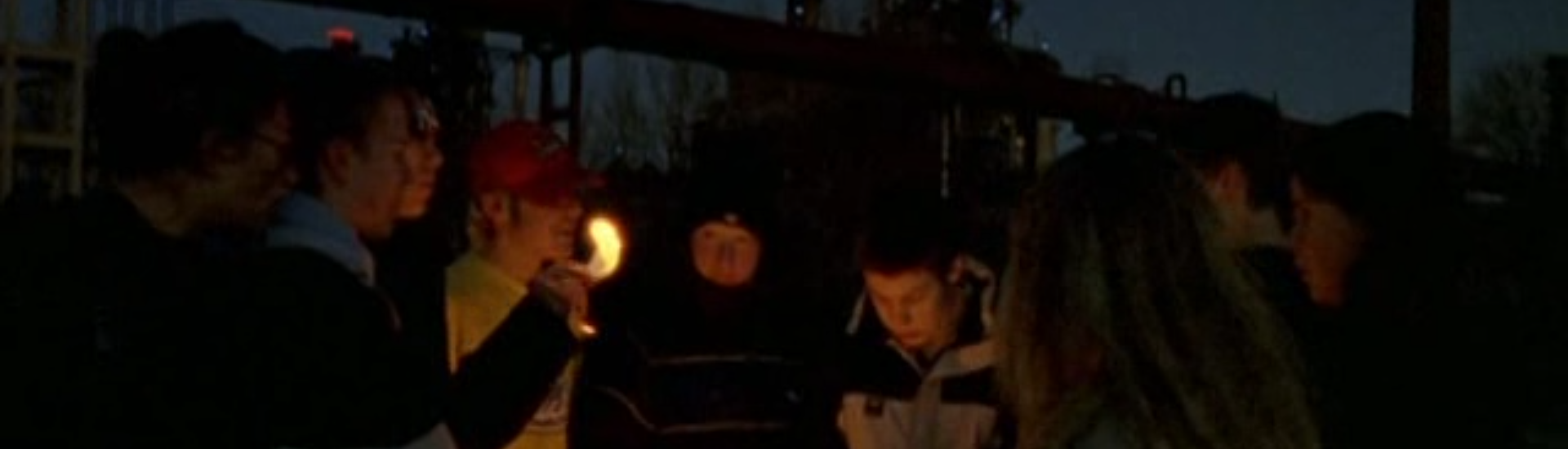
Teenagers playing in Landschaftspark, captured 2025. Workingman’s Death 2005.
Operating from 1901, the Thyssen Ironworks produced iron through both peacetime and war, from the rise of nations to their downfall. The land it sits on had long ago slipped from public hands, used instead by a procession of leaders for the supposed benefit of the state. Having produced iron through WWI, WWII, and the partitioning of Germany, the ironworks finally closed down in 1985. In 1989, architect Peter Latz won the contract to restore the disused plant, and work soon began to address the site’s troubled history.
Reclamation, as an act, requires us to understand what was lost in the first place. Our public spaces, once open to all, have been systematically enclosed in service to industry, and reclaiming the Thyssen Ironworks would involve reversing this enclosure. In recovering the land, we also recover the attitudes the land once engendered, namely, a sense of the commons.
Restoration was completed in 1994, transforming the Thyssen Ironworks into Landschaftspark Duisburg-Nord (North Duisburg Landscape Park). Latz made sure to incorporate the ironworks’ history into the park, opting to build around its major structures rather than demolish them. In doing so, an emphasis on memory began to develop organically. Visitors cannot help but transport themselves back to the old ironworks, the blast furnaces roaring against the dark sky, before snapping back into the greenery surrounding them: a reminder of how much things have changed. Through meticulous planning, Latz has managed to fold the industrial site back into the commons of public space, while retaining memories of its past.
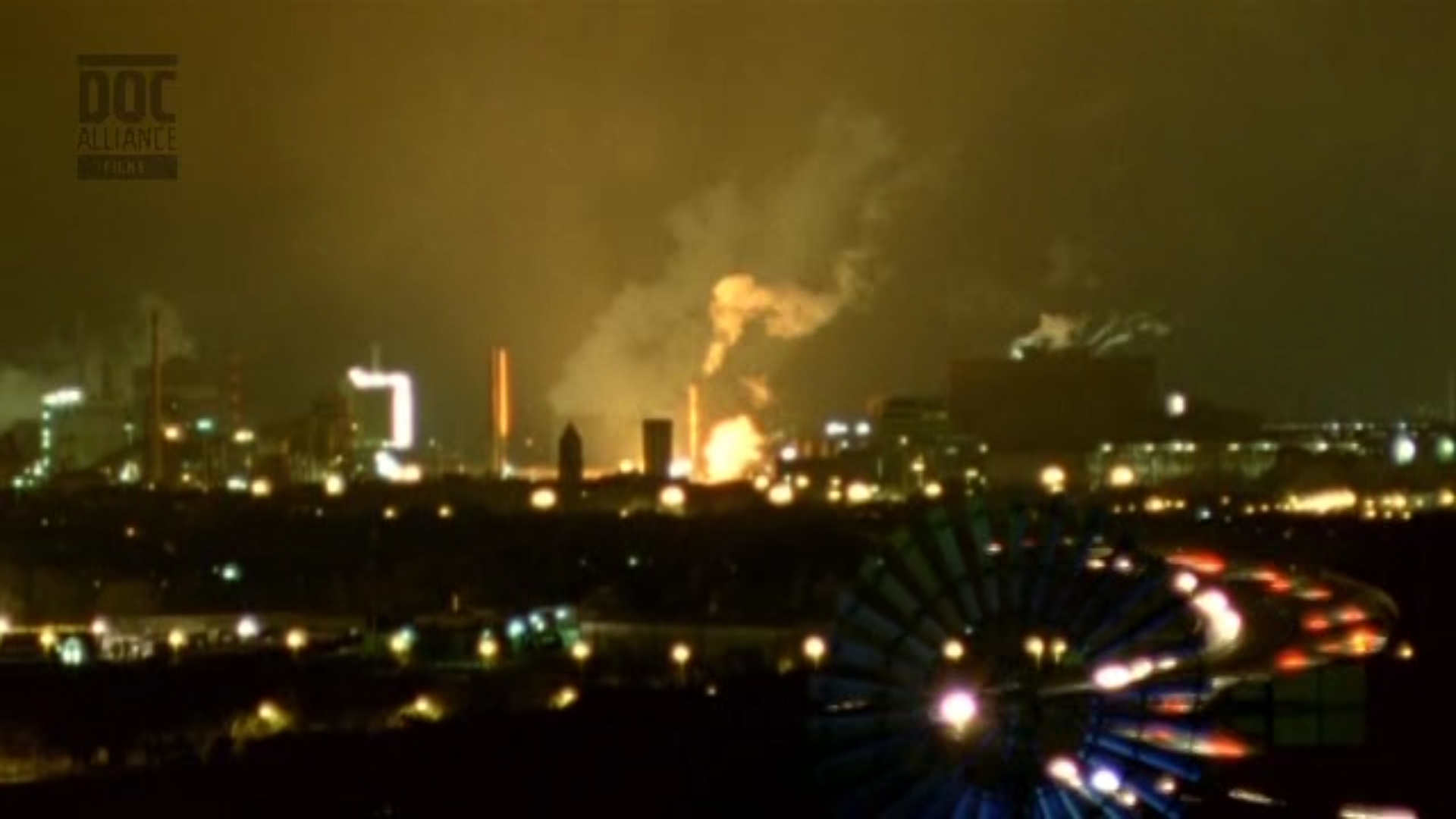
Landschaftspark at night, captured 2025. Workingman’s Death 2005.
As teenagers play, smoke, make out, and act like the nuisances they’re expected to be, lights illuminate the ironworks’ web of pipes and towers. Its proud blast furnaces, which once stood as flaming monuments to the site’s uncontested dominion over the land it occupies, are now doused in gentle blue and green. The red fire has been extinguished, no longer burning for the purposes of construction and destruction.
Looking at the remains of the ironworks, it’s worth noting that while the tangle of unyielding metal crisscrossed with innumerable pipes, cables, and struts, seems chaotic, it isn’t. It is instead laid out in a form appropriate for its industrial ambitions. It may appear random, but only because the language of industry can be unintelligible to us.
The men of the ironworks were forced to speak on these industrial terms: of hazards and safety, of regulations and inspections, of pressure gauges and release valves, of liquid death, and of solid creation. The orderly and systemic aspects of our minds are embodied in the plant’s geometric shapes, sharp corners, towering structures, and rust-red metal. It’s a language some speak better than others, but nonetheless, it’s a foreign language to many.
In the end, the mighty ironworks succumbed to the ever-present pressures of the natural world, and in doing so, released from its industrial form both the minds and bodies of the men under its yoke. In freeing its creators from the endless toil of man-made life, there was finally some much-deserved rest for the ironworks’ men. A small victory, hopefully one of many, for the workingman and their families.