
Miner carrying sulfur, captured 2025. Workingman’s Death 2005.
Although the vast majority of global sulfur is produced as a byproduct of petrochemical refinement, Indonesia still mines sulfur the old-fashioned way (Knight, 2014). In 1968, almost 3 km above sea level, the first condensation pipes were laid down to start extracting sulfur from the Ijen volcano. Ever since then, miners have walked 3km up the rim of the volcano and down another 300 m into the volcano’s crater, just to earn a living.
Picking away at the solidified sulfur that has pooled under the pipes, miners fill their wicker baskets with around 80–90 kg of sulfur (Revolve Media, 2017). After loading, they ascend back up the rim and down the mountain to the measuring station, where a truck is waiting to carry the sulfur to a makeshift processing plant. Miners earn $3 – $5 per trip, depending on the weight they’re able to carry, and with two trips in a day, they can earn up to $10. Many miners come from the local regencies of Situbondo and Banyuwangi, where there is little else that pays as well, with farmers and coffee bean pickers expected to make about half as much as the miners earn (Harsaputra, 2011).
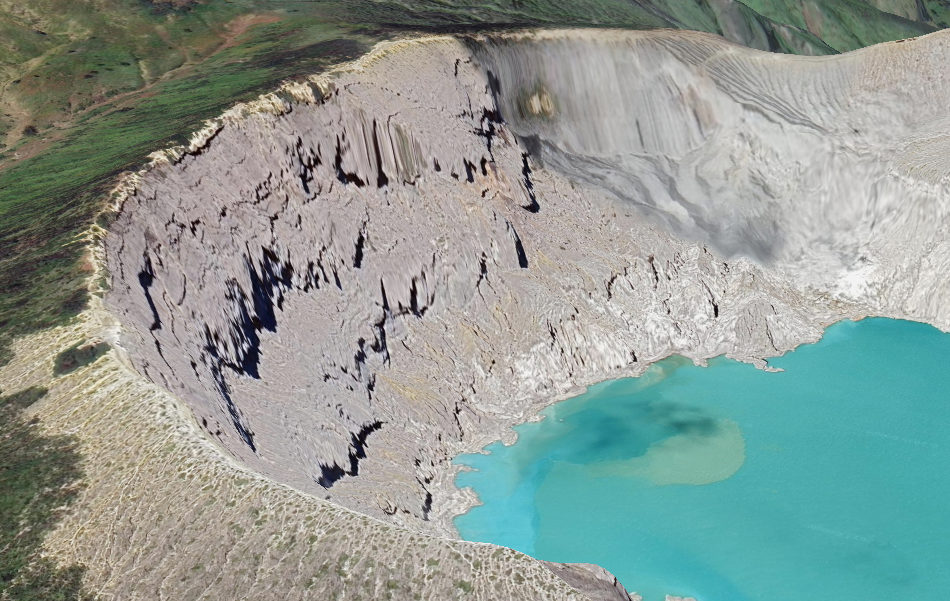
Mount Ijen’s crater with visible sulfur run off, captured 2024. 8°03’32S 114°14’44E. Google Earth 2025
The risks are numerous. Besides the obvious wear-and-tear to the body through mechanical strain, the crater emits noxious hydrogen sulfide (H₂S) and sulfur dioxide (SO₂), the latter of which occurs in dangerous concentrations far exceeding safety limits, wreaking havoc on the miners’ pulmonary systems (Susetyo et al. 2025). About 50% suffer from pharyngitis, 40% from bronchitis, and 30% from rhinitis (Wardojo et al. 2015). Long-term studies have not been conducted on their health, though it’s safe to assume the results would be grim. The situation is not helped by the prevalence of smoking in Indonesia, with the tobacco industry having successfully convinced approximately 65% of the male population to smoke, one of the highest rates in the world (World Health Organization, 2021).
Long-term health consequences aside, there are also numerous immediate threats, such as gas explosions, which killed 49 workers in 1976 and another 25 workers in 1989 (Revolve Media, 2017). In 2018, there was a toxic gas emission leading to the poisoning of 30 people in the surrounding villages, forcing authorities to close down the volcano to tourist activities (ReliefWeb, 2018). It is not clear whether the mining firms were also forced to cease operations.
Despite these risks, very few of the miners wear any kind of protective gear. The mining company PT Candi Ngrimbi technically employs the miners as freelance contractors, obviating the need to provide them with any form of equipment, accident insurance, or pension (Graham, 2013). The local government claims to have provided miners with equipment, but insists that the miners prefer not to use it. While there may be some validity to this claim, considering that gas masks would hinder breathing during strenuous tasks, it does not explain why miners resort to stuffing their mouths with fabric if proper equipment is actually available.
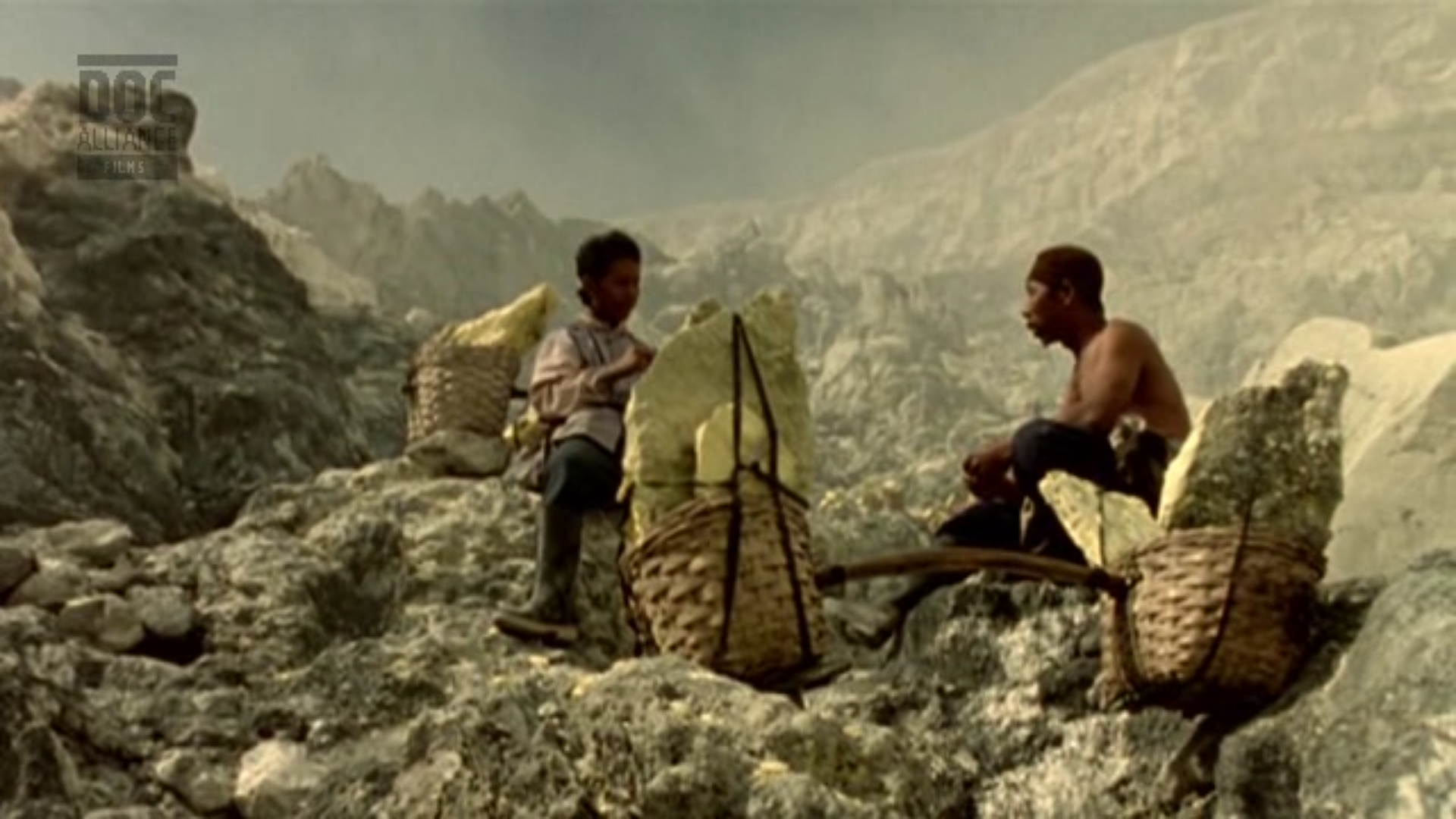
Miners taking a break, captured 2025. Workingman’s Death 2005.
The miners in the documentary are aware of this perilous situation, starting the chapter with the sacrifice of a goat, whose head they bury in the sulfur as protection against the dangers they’re all too familiar with. Unlike the other chapters of the documentary, the miners do not work and talk at the same time, only one or the other. Under the heavy load of their baskets, they remain silent, looking only a few meters ahead and using the natural springiness of the loaded baskets to add a much-needed bounce to their step. Their silent toil is broken up at rest stops along the crater, where small talk gives many a much-needed respite from their heavy burdens; recollections of drunken fights, their favorite woman at the brothel, tall tales of kissing tourists, and their favorite western bands.
At the rim of the volcano, after having ascended a steep 300m, they are rewarded by a throng of tourists, gleefully taking pictures and asking the miners inane questions such as “How much weight do you carry?” or “Is it hard work?” One wonders how often they’ve had to answer these, and if they ever exaggerate just for a laugh among themselves. After descending 3km down the mountain and reaching the weighing station, they earn their pay, proceeding to dump their devil’s gold into the waiting trucks. For most of them, it’s their second and final trip of the day. As they leave for home, the miners throw their baskets up into a tree for storage until the next day comes.
The term poverty tourism gets used often, but it seems particularly applicable here. Starting in 2010, the local regent of Banyuwangi initiated a large tourism drive (Bresnahan, 2020). This push towards tourism has been very lucrative for the surrounding region, with the two largest hotels bringing in about $5000 in income for the local government, not to mention the myriad of supporting jobs they help create (Harsaputra, 2011). However, besides the odd sulfur-cast souvenir or photo charge, the actual miners who are responsible for the surreal scenes atop the volcano see very little of this wealth. In what seems like a rite of passage for documentary filmmakers and serious travel photographers, the miners are continual subjects for film, photography, art, and commentary. This very article itself is guilty of this charge. If the miners were to stop working, it would just become another volcano, devoid of the exploitative nature that makes it so morbidly interesting in the first place.
The local economy’s newfound prosperity also doesn’t seem to be helping with the deteriorating ecological situation around the volcano. On its way down to the sea, the highly acidic crater water, containing hydrochloric acid and sulfuric acid, mixes with local water supplies, polluting rivers and wells. This pollution is responsible for widespread bone and tooth damage within local settlements. There are high numbers of people in the surrounding region who suffer from fluorosis caused by excessive fluoride in the water. The polluted water also travels through paddy fields, plantations, and sugar mills, greatly reducing agricultural output for those most in need. Even the national bird of Indonesia, the Javan hawk-eagle, is not spared. Local population levels of the bird have dwindled from ten pairs in 1996 to just two in 2011 (Harsaputra, 2011).
Yet despite all the difficulties, many miners take pride in their work, using their earnings to provide for their family and ensure their children get enough education to avoid their parents’ fate. Many miners hope they will be the last generation working in the crater, recognizing the dangerous nature of their job. But unless opportunities improve in the local regions, the surreal scenes of grueling exploitation along the slopes of Mount Ijen will persist, along with the never-ending line of gawking tourists.
References
Harsaputra, I. (2011). Kawah Ijen between potential threat. [online] The Jakarta Post. Available at: https://www.thejakartapost.com/news/2011/12/19/kawah-ijen-between-potential-threat.html [Accessed: 16 July 2025].
Bresnahan, C.O. (2020). Tourists at Kawah Ijen Crater. [online] The Borgen Project. Available at: https://borgenproject.org/tourists-at-kawah-ijen-crater/ [Accessed: 16 July 2025].
Graham, D. (2013). Trapped under the yellow yoke. [online] The Jakarta Post. Available at: https://www.thejakartapost.com/news/2013/10/06/trapped-under-yellow-yoke.html [Accessed: 16 July 2025].
Henriques, M. (2019). The men who mine the ‘Devil’s gold’. [online] BBC Future. Available at: https://www.bbc.co.uk/future/article/20190109-sulphur-mining-at-kawah-ijen-volcano-in-indonesia [Accessed: 16 July 2025].
Susetyo, S.H., Abidin, A.U., Sano, K., Yoneda, M. and Matsui, Y. (2025). Toxic natural pollution at Ijen crater volcano: Environmental characteristics and health risk assessment. [online] Toxicology Reports. Available at: https://doi.org/10.1016/j.toxrep.2025.101899 [Accessed: 16 July 2025].
Wardojo, S.S.I., Prasetyo, Y.B. and Masruroh, N. (2015). Developing Comprehensive Prevention Strategies Towards Reducing
Occupational Disease Among Sulfur Miners in Ijen Crater Eastern Java. [online] Advances in Environmental Biology. Available at: https://www.aensiweb.net/AENSIWEB/aeb/aeb/2015/October/50-54.pdf [Accessed: 16 July 2025].
ReliefWeb (2018). Ijen Crater tourist site closed due to toxic gases. [online] ReliefWeb. Available at: https://reliefweb.int/report/indonesia/ijen-crater-tourist-site-closed-due-toxic-gases [Accessed: 28 July 2025].
Revolve Media (2017). Toxic fumes. [online]. Available at: https://revolve.media/views/toxic-fumes [Accessed: 16 July 2025].
World Health Organization (2021). Indonesia national 2021 fact sheet [online]. Available at: https://cdn.who.int/media/docs/default-source/ncds/ncd-surveillance/data-reporting/indonesia/indonesia-national-2021-factsheet.pdf [Accessed: 16 July 2025].
Laurence Knight (2014). Sulphur surplus: Up to our necks in a diabolical element. [online]. Available at: https://www.bbc.co.uk/news/magazine-28369829 [Accessed: 19 July 2025].